
A Clear Guide to Halal Ingredients: Plant-Based, Meat, and Natural Sources
Short Summary
Halal ingredients form the backbone of all halal-certified products. They are not limited to meat but also include plant-based materials and natural resources that comply with Islamic dietary laws. In today’s global food industry, understanding these ingredients is essential for ensuring product integrity, consumer trust, and long-term business growth in the halal market.
Introduction
The concept of halal is often misunderstood as being limited only to meat products. In reality, halal refers to everything that is permissible according to Islamic law, including food, beverages, ingredients, and even the way products are processed, stored, and transported.
As global awareness increases, consumers are becoming more conscious about what they consume. They want assurance not only about taste and quality but also about ethical sourcing, hygiene, and compliance with religious guidelines. This shift has made halal integrity more important than ever.
For businesses involved in food manufacturing, processing, importing, or exporting, understanding halal ingredients is not optional—it is essential. A single non-compliant ingredient can affect the entire product’s halal status and damage consumer trust.
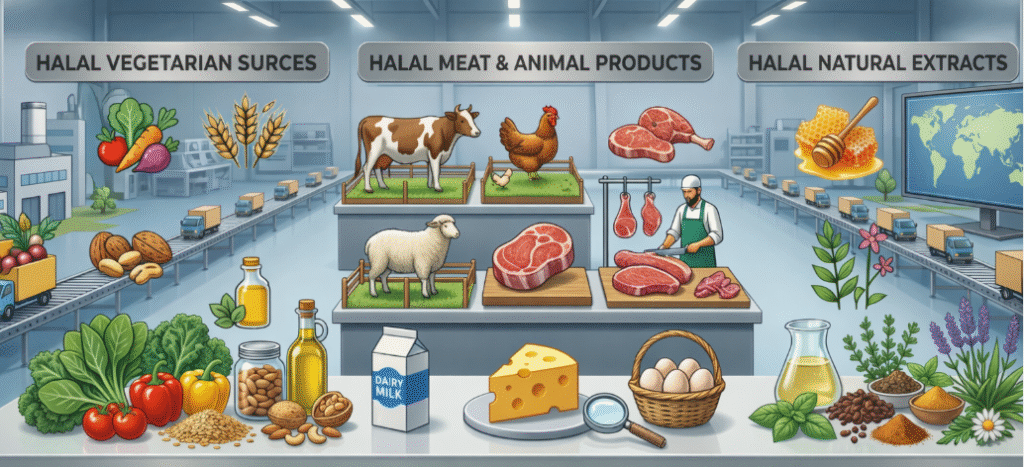
Broadly, halal ingredients can be categorized into three major groups:
- Plant-based ingredients
- Halal meat and animal-based ingredients
- Natural resources and extracts
Each category has its own rules, risks, and compliance requirements.
Plant-Based Ingredients: Naturally Halal but Operationally Sensitive
Plant-based ingredients come from fruits, vegetables, grains, nuts, seeds, and other botanical sources. By nature, they are considered halal. However, their halal status can still be compromised during industrial handling.
Role in the Food Industry
Plant-based ingredients are widely used in:
- Processed snacks and packaged foods
- Bakery products such as bread, cakes, and biscuits
- Beverages including juices, soft drinks, and energy drinks
- Vegan and vegetarian food products
- Sauces, spreads, and condiments
With the rising demand for plant-based diets, these ingredients are becoming even more important in both halal and non-halal markets.
Hidden Risks in Plant-Based Processing
Even though the raw source is halal, risks can occur during:
- Manufacturing and processing
- Shared production equipment
- Transportation and storage
- Use of additives and stabilizers
For example, if plant-based ingredients are processed in a facility that also handles non-halal products, cross-contamination may occur. This can immediately compromise the halal certification of the final product.
Key Compliance Practices
To ensure plant-based ingredients remain halal:
- Maintain separate or fully sanitized production lines
- Verify all additives, preservatives, and emulsifiers
- Work with certified and transparent suppliers
- Implement strict hygiene and monitoring systems
Proper management ensures that even large-scale production remains compliant and trustworthy.
Halal Meat: The Most Regulated and Sensitive Category
Among all halal ingredients, meat is the most strictly regulated. This is because it involves both ethical treatment of animals and precise religious requirements.
Requirements for Halal Slaughter
For meat to be considered halal, several conditions must be met:
- The animal must be healthy at the time of slaughter
- The slaughter must be performed by a mentally sound adult Muslim
- The name of Allah must be invoked during the process
- The blood must be fully drained from the body
- The animal must not be tortured or treated inhumanely
These rules ensure both spiritual compliance and hygiene standards.
Beyond Fresh Meat: Processed Animal Ingredients
Halal compliance does not only apply to raw meat. Many processed foods contain hidden animal-derived ingredients such as:
- Gelatin used in desserts, capsules, and confectionery
- Enzymes used in cheese production
- Animal-based fats and emulsifiers
- Broths and flavor enhancers
If these ingredients are sourced from non-halal animals or improperly processed, the entire product becomes non-halal—even if the rest of the ingredients are compliant.
Importance of Supply Chain Traceability
In modern global trade, meat ingredients pass through multiple suppliers, processors, and distributors. Without proper traceability, it becomes difficult to verify halal compliance.
Businesses must ensure:
- Certified halal slaughterhouses
- Verified international suppliers
- Proper documentation at every stage
- Transparent supply chain tracking systems
This builds consumer confidence and reduces regulatory risks.
Natural Resources: Simple Ingredients with Hidden Complexity
Natural resources include ingredients derived from natural sources such as plants, minerals, and animals without direct processing into food products. While they appear simple, they are not always risk-free.
Common Natural Ingredients Used
- Honey and natural sweeteners
- Herbs, spices, and botanicals
- Natural flavor extracts
- Mineral water and spring water
- Natural colorants derived from plants
These ingredients are widely used in health, wellness, and organic food industries.
Hidden Halal Risks
Even natural ingredients can become non-halal due to:
- Use of alcohol during extraction or processing
- Contamination with non-halal substances
- Mixing with animal-derived components
- Improper storage or handling practices
For example, natural flavoring agents may use alcohol as a carrier, which can affect halal status depending on certification standards.
Ensuring Compliance in Natural Ingredients
To maintain halal integrity:
- Verify extraction methods and solvents used
- Ensure halal-certified processing facilities
- Check third-party certification status
- Maintain transparent supplier communication
Careful verification is essential, especially for imported ingredients.
Processing Stage: Where Halal Integrity Is Most Often Compromised
Even when all raw ingredients are halal, the processing stage is one of the most critical points where compliance can be lost.
Common Risks in Processing
- Shared machinery with non-halal production lines
- Inadequate cleaning procedures
- Mixing of storage containers
- Lack of staff awareness about halal requirements
These issues often occur in large-scale industrial facilities where multiple product lines are produced.
Best Practices for Halal Processing
- Dedicated halal production lines
- Strict cleaning and sanitation protocols
- Segregated storage areas
- Continuous staff training on halal compliance
Many companies now invest in fully halal-certified facilities to eliminate risks entirely.
Importance of Halal Certification in Modern Industry
Halal certification is the foundation of trust in the global halal market. It confirms that every stage of production complies with Islamic guidelines.
What Certification Covers
- Ingredient sourcing and verification
- Manufacturing and processing procedures
- Packaging and labeling accuracy
- Storage, transportation, and distribution
Why Certification Matters
For businesses:
- Expands access to global halal markets
- Strengthens brand reputation
- Reduces compliance risks and legal issues
For consumers:
- Ensures confidence in product safety
- Provides religious assurance
- Builds long-term brand loyalty
In today’s competitive food industry, certification is no longer optional—it is a necessity.
Why HalalManufacturers.com?
Finding trustworthy halal suppliers is one of the biggest challenges in the industry, especially for international buyers. HalalManufacturers.com helps bridge this gap.
Platform Benefits
- Access to verified halal-certified manufacturers
- Transparent supplier information and profiles
- Direct communication with producers
- Reduced risk in sourcing decisions
Supporting Global Business Growth
The platform helps importers, exporters, and distributors:
- Save time in supplier verification
- Ensure consistent product quality
- Expand into new halal markets confidently
- Build reliable global supply chains
It acts as a trusted bridge between businesses and certified halal producers worldwide.
Key Challenges in Managing Halal Ingredients
Despite growing awareness, several challenges still exist:
- Complex ingredient supply chains
- Different halal certification standards across countries
- Risk of cross-contamination in shared facilities
- Difficulty verifying processed ingredients
- Lack of transparency from some suppliers
These challenges highlight the importance of strong systems and reliable partnerships.
Evolving Consumer Expectations in the Halal Market
Modern halal consumers are becoming more informed and selective. They expect more than just certification.
Today’s expectations include:
- Clean-label and natural ingredients
- Ethical and sustainable sourcing
- Transparent production processes
- High-quality and safe products
This shift is pushing businesses to improve not only compliance but also overall product quality and transparency.
Conclusion
Halal ingredients are much more than a religious requirement—they represent trust, quality, and responsibility in the global food industry. From plant-based sources to halal meat and natural resources, every ingredient plays a vital role in ensuring product integrity.
For businesses, success in the halal market depends on strict compliance, transparent sourcing, and strong supplier relationships. As demand continues to grow worldwide, companies that prioritize authenticity and quality will lead the future of the halal industry.
Frequently Asked Questions
Are plant-based ingredients always halal?
Yes, plant-based ingredients are generally halal. However, they must be processed and handled properly to avoid contamination with non-halal substances.
Why is halal meat strictly controlled?
Halal meat follows strict Islamic guidelines regarding animal welfare, slaughter method, and hygiene to ensure both ethical and religious compliance.
Can natural ingredients become non-halal?
Yes, natural ingredients can become non-halal if alcohol is used during processing or if they are contaminated with non-halal substances.
Why is halal certification important?
Halal certification ensures that products comply with Islamic guidelines, builds consumer trust, and supports global trade opportunities.